
Sponge Stick Rotation
- Play time:
- 10 to 15 minutes
- Setup:
- 5 minutes
- Where:
- Table
Why it helps
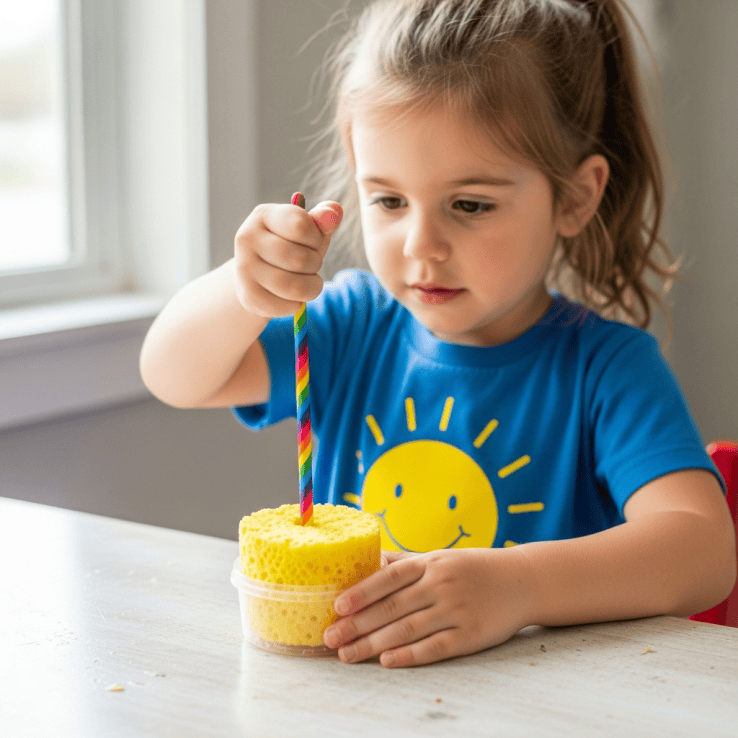
This activity is fantastic for developing the small muscles in the hands and forearms. When your child twists the stick into the tight sponge, they get important feedback (proprioception) about how much force to use. The twisting motion strengthens the muscles responsible for forearm rotation (pronation and supination). These muscles are critical for everyday tasks like turning doorknobs, twisting open lids, and maneuvering a pencil while coloring or drawing. Stabilizing the container with the non-dominant hand helps build proximal stability, which is the strong foundation needed for fine motor control.
Steps
- Before play, use scissors to cut 6 to 8 small slits, about 1 inch deep, into the soft side of the sponge.
- Put a little water in the bowl. Ask your child to dunk the sponge and squeeze it out hard, so it is damp but not dripping.
- Place the damp sponge in the container, slit side up, to keep it steady on the table.
- Ask your child to hold the container steady with the helper hand and pick up a craft stick with the working hand.
- Show your child how to push the end of the stick into a slit while twisting it back and forth, like turning a key, until it is halfway in.
- Keep twisting sticks in until the sponge looks like a prickly cushion. Then twist and pull them out one by one.
Safety tip: Keep the scissors with you during prep. Wipe up spills so the floor does not get slippery, and empty the water bowl when you are done.
Make it easier
- Use a very soft, wet sponge so the sticks go in with less force.
- Push the sticks in straight first, then add the twist once your child has the idea.
- Use just three or four sticks so the job is done before the hands get tired.
Make it harder
- Use a drier, denser sponge, which takes stronger twists.
- Twist one stick in with the palm facing up, then the next with the palm facing down.
- Cut the slits in a ring near the edge of the sponge and twist the sticks in to make a circle.
What to watch for
- Notice whether the twist comes from the forearm turning or from the whole arm swinging. Keeping the elbow tucked near the body helps the forearm do the work.
- Watch the helper hand. Pressing the container down keeps the sponge from spinning along with the stick.
- If wet hands are unpleasant, use a dry sponge and keep a towel nearby for wiping.
Where this helps in daily life
Twisting with the forearm while the other hand holds steady is the same movement kids use to turn a doorknob, open a jar, and twist a faucet handle.
Need personalized support?
While these activities are great for home practice, nothing replaces the guidance of a licensed therapist. If you are in Irvine, CA or the Orange County area and have concerns about your child's Forearm Pronation, we invite you to connect with us.
Contact Tumble N' Dots Therapy →These activities are for home practice and don't replace the guidance of a licensed therapist.


