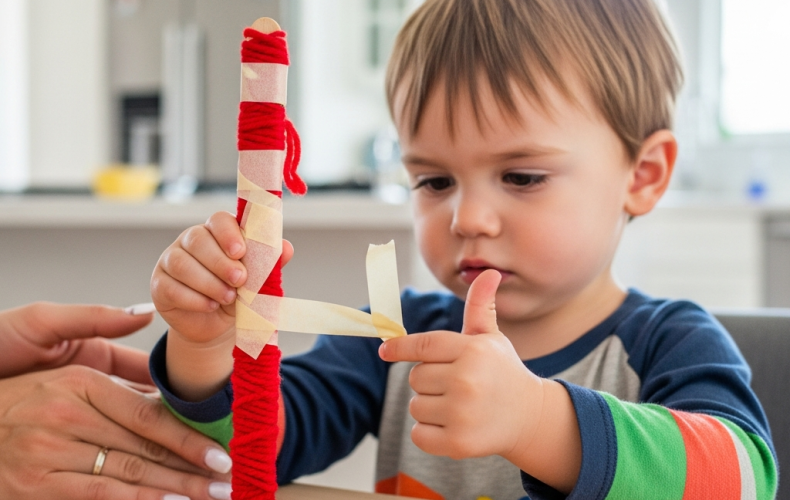
Ribbon Resistance Unwind

Ribbon Resistance Unwind

Steps:

  • Adult Prep: Cut several strips of ribbon (about 12 inches long). Secure one end of a ribbon strip firmly onto a craft stick using a small piece of masking tape.
  • Adult Prep: Tightly wrap the ribbon all the way down the stick until it is completely covered. Secure the loose end of the ribbon/stick assembly firmly inside the plastic container with more masking tape (this anchors the stick).
  • Have your child sit at a table and hold the plastic container steady with their helper hand to prevent it from sliding. This requires proximal stability.
  • Challenge the child to use their working hand to pinch the exposed end of the ribbon. Encourage them to use a strong, controlled pull and unwind motion to free the ribbon from the stick.
  • Once the ribbon is completely unwound, gently peel the starting tape off the stick and wrap a new ribbon tightly around the stick to play again.

Safety Tip:
Ribbon and small pieces of masking tape are small objects. Constant adult supervision is required to prevent choking hazards for children in this age group.

Sticky Ribbon Rescue

Sticky Ribbon Rescue

Steps:

  • Adult Prep: Tightly wrap a piece of Yarn or Ribbon around a Craft Stick. Secure the ends of the yarn with small, strong strips of Masking Tape.
  • Place the finished stick and the empty Container on a stable table.
  • Challenge your child to hold the stick firmly with their helper hand to keep it still.
  • Encourage your child to use their working hand to pinch an edge of the tape. Pull the tape strip off slowly against the resistance.
  • Once the tape is peeled, they can unwrap the yarn and drop the ‘rescued’ ribbon into the Container. Repeat with other prepared sticks!

Safety Tip:
Ribbon, yarn, and small pieces of masking tape are choking hazards for children under three. Constant, direct adult supervision is required throughout this activity. Ensure the child remains seated and materials are not placed near the mouth.

Ribbon Slot Stuffing

Ribbon Slot Stuffing

Steps:

  • Adult Prep: Use the Scissors to cut three tight, narrow slots (about 1.5 inches long) into the Cardboard or the lid of the Container. Secure the Cardboard/lid tightly using Masking Tape.
  • Give the child long strips of Ribbon. Encourage them to use both hands to tear the Ribbon into small, stamp-sized pieces. Tearing wakes up the hand muscles!
  • Ask your child to hold the container steady with their helper hand (proximal stability) while it sits on the table.
  • Pick up one torn Ribbon piece. Crumple it tightly into a small ball using only their fingertips (working on pincer grasp and in-hand manipulation).
  • Aim the crumpled ribbon ball at a slot. Use a controlled, firm push with the index finger or thumb to send the ribbon piece completely inside the container. Repeat until the container is full!

Safety Tip:
Ribbon pieces are small objects. Constant and direct adult supervision is required throughout the activity, as they pose a choking hazard for children under five.

Ribbon Ring Tie

Ribbon Ring Tie

Steps:

  • Adult Prep: Use the hole puncher to create 8 to 10 holes evenly around the rim of the plastic container. Cut the ribbon into short, 6-inch strips.
  • Place the container on the table. Encourage your child to use their non-dominant hand to hold the container steady (proximal stability).
  • Take one ribbon strip and thread one end through a punched hole using their dominant hand’s fingertips.
  • Challenge your child to grasp both ribbon ends tightly with their thumb and pointer finger, pulling them to tie a simple knot or loop around the edge of the container.
  • Repeat this process, tying colorful ribbons onto every hole around the container to create a decorative, ‘fringed’ look.

Safety Tip:
Adult supervision is essential. Small pieces of ribbon pose a choking hazard if placed in the mouth. Ensure the child focuses only on the tying task.

Paper Bag Fish

Have the child crumple the newspapers into small paper balls.

Stuff the paper bag with the crumpled newspapers.

Use the yarn or a ribbon to tie a knot close to the edge of the open end to close the paper bag.

Ask the child to paint the filled paper bag using either a brush or cotton balls.

Glue large googly eyes.

For grading, you can ask the child to draw eyes on construction paper and cut/glue it onto the paper bag.

Lay a piece of yarn on the fish (below the eyes) to make a mouth. Use some glue to hold it in place.

To promote tactile perception, you can let the child finger paint the paper bag instead of using other media.